Welcome, Friends: Understanding the Estate/Trust Hijack Trap
A Straightforward Warning for Families, Seniors, and Financial PoAs:
Look around this room. Many of us here spent our lives building real things — carpentry, teaching, working honest trades — and we managed to put away a nest egg of over a million dollars. We think we're safe. We think that as long as we keep our bank statements organized and pick a child to hold our Power of Attorney, our sunset years are secure. We work with an attorney who is highly trained in estate planning to put a solid, comprehensive written plan in place from the start. We are leaving the back door wide open.
Securing the financial paperwork alone does not mean your estate is secure. The most destructive administrative threats don't break in through a window; they exploit a hidden trap door in our legal and banking systems—the dangerous gap between who holds your physical keys and who looks after your money.
This archive exposes a white-collar playbook known as The Estate Hijack. When a family member holding your medical or physical power of attorney loses touch with the actual estate structure, an opportunistic third party can step in and stage a swift, multi-stage takeover.
The 4-Step Hijack Playbook:
- 1. Insecurity Meets Opportunity: It starts when a loved one holding your Health Care PoA feels overwhelmed by complex estate rules. Instead of admitting they don't understand it — or talking to the family lawyer who drafted it — they wander into a retail bank or talk to an unvetted retail financial salesperson hungry for management fees and commissions.
- 2. Manufactured Panic & The Secret Trap: Instead of educating your family, the salesperson weaponizes their confusion. They make normal, everyday financial transactions look like reckless mismanagement and whisper about hidden theft. To keep your family from checking the facts with your real attorney, they demand absolute secrecy — framing it with a conspiratorial mindset: "Don't tell anybody we know, we have to catch them."
- 3. Poisoning the Legal Well: Armed with a fictional story of missing fortunes, your loved one hires legal counsel. Because that attorney relies on the retail advisor's filtered, distorted summaries instead of checking with the original drafting lawyer, a complete fabrication enters the formal court record entirely unchallenged.
- 4. The Forced Takeover: To finish the job, the advisor cranks up the urgency — demanding immediate liquidation of accounts and moving your life savings into new institutions under their direct personal control. Even if corporate job changes or bank delays slow them down, they keep feeding libelous reports to judges until the court hands over complete control.
The Hard Truth: A Systemic Blind Spot
There is no simple checklist that can stop a bad actor who already holds your physical care keys. If someone with a Health Care PoA decides to hijack an estate, our court and banking systems default blindly to whoever has physical custody. The financial administrator gets locked out in the cold. By the time anyone realizes the crisis was completely made up, the money is gone, the legal narrative is locked in stone, and the damage cannot be undone.
Anatomy of a Takeover: How a Retail Salesman Plays the System
An estate hijack doesn't rely on high-tech computer hacking or crude document forgery. It relies on predictable human blind spots: trusting someone behind a bank desk just because they wear a suit, and letting panic override common sense.
To show you how this machinery operates in broad daylight, this archive walks through the Veazey Estate Case Study as a blueprint. By examining real court transcripts, bank records, and sworn depositions, we expose the exact playbook used to isolate trustees, poison judges, and strip families of their protections.
1. The Universal Hijack Sequence
-
Stratagem A: Weaponizing Inexperience
When a family caregiver doesn't understand trusts, they lean on retail bank employees who treat multi-million dollar estate structures like basic checking accounts. -
Stratagem B: Inventing "Account Zero"
Routine tax strategies, legitimate family gifts, and normal administrative transfers are twisted into claims of "stolen money" to invent a phantom fortune called Account Zero. -
Stratagem C: The Courtroom Game of Telephone
Attorneys and court-appointed guardians take second-hand gossip from retail brokers instead of calling the attorneys who originally built the estate plan, baking falsehoods directly into court files. -
Stratagem D: The Title Swap
With a judge's signature secured under false pretenses, trusts are shut down, accounts are drained, and assets are re-titled into guardianship accounts controlled by the advisor.
2. The Forensic Audit Framework
The evidence examined in this archive follows a strict, unyielding forensic standard:
- Document Matching: Stacking every courtroom claim directly against original bank statements, deposit slips, and tax filings.
- Deposition Scrutiny: Pulling apart sworn testimonies line-by-line to expose memory lapses, false claims, and glaring gaps in professional knowledge.
- Legal Dissection: Drawing a bright line between Medicaid trusts, LLC assets, personal funds, and legal settlements to disprove false claims of commingling.
How to Read This Case Study:
Pay close attention to Phase 3.4 (The Sharp Report) to see how unverified hearsay fooled the Delaware Chancery Court, and Phase 3.5 (The DuBreuil Analysis) to watch a retail insurance salesman manufacture theft out of perfectly legal estate distributions.
Thomas DuBreuil:
To understand how this happened, let's look at Thomas DuBreuil’s actual professional history. A 15-year career in shift production across heavy manufacturing and meatpacking plants — working at Swift & Co., Miller Brewing, and Playtex, describing himself as a "distribution technician" punctuated by frequent moves and year-long stretches of unemployment prior to transitioning into a third-shift production supervisor role in 1994 followed by retail management at Toys "R" Us. His employment record revealed a pattern of abrupt departures, institutional layoffs, and manufacturing oversight. That background was entirely devoid of complex estate planning, fiduciary law, or trust administration. Later, transitioning into financial sales with American Express and taking a retail bank specialist role at Wachovia/Wells Fargo. That exact pattern directly preceded his desperate push for commission-generating assets at Swarthmore Financial. As we’ll see, this background is critical to recognizing how routine banking counter service was weaponized into manufactured financial expertise — all to mislead legal counsel and the court.
Entering the Plot: Swarthmore Financial Services
Based in New Castle, Delaware, DuBreuil testified that his firm was "essentially... a sub-agency of Massachusetts Mutual Life Insurance Company." He was first contacted by family member Jack Beckett in October 2010.
Legal Representation Absence at the DuBreuil Depositions:
Thomas DuBreuil was deposed on January 15, 2014, and January 29, 2014. Remarkably, despite his employment history and roles tied directly to these proceedings, not a single lawyer appeared to represent the following corporate and financial institutions at his depositions:
- Rockwell Associates
- Swarthmore Financial Services
- Wells Fargo
- Pennsylvania Mutual Life Insurance Company
- Massachusetts Mutual Life Insurance Company
- Hornor, Townsend & Kent (HTK)
- Zenith Marketing
- MML Investors Services
Analyst Commentary: Corporate legal counsel's total absence strongly indicates that DuBreuil testified independently, without informing corporate officers at Hornor, Townsend & Kent, Rockwell Associates, or Pennsylvania Mutual.
Case Study Analysis: The Execution
Phase 3.1: The Estate prior to intervention
[Drafting Note: Brief summary of the estate with meso settlement overview]
Phase 3.2: The Grantor's Intent for Distribution of the Estate
[Drafting Note: Equalization distribution to Bob/Jack Beckett (MoU)]
[Drafting Note: Creation of Trust (Medicaid)]
[Drafting Note: Alberta's Will quote:no changes to Don's Administration]
Phase 3.3: Groundwork & Positioning of Subversive Actors
Good Morning Mr. [Don] Veazey
Attached please find a Waiver of Notice and Consent Delaware Chancery Court.
As your brother Jack [Beckett] might have communicated to you, it is one of the components of the petition Jack will be filing with Delaware Chancery Court to be appointed Mrs. Veazey's guardian. Please fill it out, sign and notarize it, and return it to me at the address below. Please note, I also sent this by letter yesterday...
Jessie O. Molina,
Legal Administrative Assistant to
Robert L. Thomas, Esquire
Young Conaway Stargatt & Taylor, LLP
Seems like just a request for guardianship, OK I sign a Waiver of Notice and Consent from Delaware Chancery Court.
Analyst Commentary: Mr. Thomas would prefer Don not hear what Sharp will allege in court.
[Email body content to be added re: DuBreuil's meddling (why was an insurance salesman brought in to evaluate an estate including a gifting trust?) DuBreuil shoehorns himself into discussions. this email indicates more to be discovered]
[Drafting Note: evaluation of DuBreuil's Stratagem A:]
Phase 3.4: The Catalyst (The Sharp Report)
The Report of the Attorney Ad Litem June 21, 2011
James P. Sharp, Esquire
Attorney Ad Litem
122 West Market Street
P. O. Box 554
Georgetown, DE 19947
IN THE COURT OF CHANCERY OF THE STATE OF DELAWARE C.M. No. 15916-S
I. Evaluation of Opening Premises
Sharp took my statement regarding mom's finances while I was touring Alcatraz in San Francisco. Sharp struggled with my explanation of an irrevocable trust.
Sharp States:
"According to Don, he consulted with a Virginia attorney named John Ryan to create a Trust and Limited Liability Company on his mother's behalf. He explained to me that the settlement proceeds were put into the Trust for Alberta's benefit. When she passes away, the remaining assets will go to her children."
DuBreuil originated this explanation a year prior and is a fabrication that does not reflect my communication with Sharp. I unequivocally explained that the trust was an irrevocable Medicaid Trust funded with a $285,000 gifted to the trust June 2009. I did not make this statement alleged by Sharp and this statement contaminates Sharp's entire presentation to the court.
Sharp notes discussions with Thomas (who was himself in discussions with attorney John Ryan), yet no mention is made of this vital context. This suggests a significant breakdown in the relay of accurate information, either from Thomas to Sharp, or in Sharp's subsequent reporting.
Sharp seems to have called Ryan while Ryan was on vacation and it appears Sharp didn't bother to make contact.
Analyst Commentary: The failure of the Court-appointed Attorney Ad Litem to directly contact, interview, and understand the legal architecture established by attorney John Ryan is not a minor oversight—it is a catastrophic, unprofessional, and disqualifying breach of forensic due diligence. Ryan was the legal architect who drafted the Memorandum of Understanding (MoU) designed specifically to protect the estate’s assets. By refusing to secure first-hand testimony from the actual drafting counsel, Sharp chose instead to rely on a filtered, distorted game of telephone curated by a retail bank customer service representative (DuBreuil) and hostile family members who lacked the requisite legal expertise.
This omission was profoundly destructive to Don Veazey's reputation. By remaining willfully ignorant of Ryan's actual legal directives, Sharp painted Don Veazey’s legitimate, structured asset preservation efforts not as a standard elder-law Medicaid protection strategy, but as a chaotic, suspicious, and unauthorized "abdication" of duty. To present a formal evaluation of estate architecture to a Delaware Chancery Court Judge without ever validating that architecture with the licensed attorney who built it is a stunning display of professional laziness. It allowed a completely fabricated narrative of financial mismanagement to enter the official court record completely unchallenged, effectively poisoning the well and assassinating Don Veazey’s credibility before he ever had a chance to speak.
Sharp States:
"Jack has some questions about the establishment of the Trust"
Analyst Commentary: October 15, 2009, Jack Beckett personally participated in and witnessed DuBreuil’s review of the Trust and LLC Operating Agreement documents with the family, DuBreuil executing the documents himself. Having subsequently lost his copies, Jack Beckett requested and received replacements from me. This transaction coincided precisely with DuBreuil’s initial involvement and the immediate disruption of the original estate plan.
II. Comprehensive Financial & Asset Analysis
Sharp States:
"When I spoke with Don, I specifically asked him about his mother's finances ... Don advised me that the Trust consisted of the following:
1) the house at Postal Lane,
2) a money market account with approximately $10,000.00,
3) a checking account with approximately $6,000.00, and
4) a stock brokerage account with approximately $19,000.00."
The following constitutes the correct, accurate, and precise detail of Trust and Estate assets as of March 1, 2011. This excerpt is derived from documentation provided by Jack Beckett in accordance with discovery in the Virginia litigation, which documentation was under Jack Beckett's control as of the date of this report:
Correct List of LLC (Trust) Assets — June 1, 2011:
- Real Property: The house at Postal Lane.
- Money Market Account: Wells Fargo [20000 3103 3345] with approximately $10,000.00.
- Checking Account: Wells Fargo [20000 3103 3332] with approximately $6,000.00.
- Stock Brokerage Account: LPL [5451-7282] with approximately $400,000.00.
- Annuity: Nationwide [01-6049490] with approximately $200,000.00.
Correct List of Alberta's Personal Estate Assets — June 1, 2011
- Vehicles: A car valued at $13,000; a truck valued at $3,000.
- Stock Brokerage Account: Approximately $19,000.00 including 200 shares of Lowe's stock valued at approximately $4,000.00.
- Safety Deposit Box: Gold valued at $30,000.00, silver service set valued at $6,000.00, and four coins valued at $2,400.00.
- Outstanding Debt: Bob's debt of $40,000.
- Banking: Wells Fargo checking and Wells Fargo money market.
Analyst Commentary: Total estate assets June 2011: $113,400.00.
(Drafting Note: Ryan email to Thomas re: above.)
Generalized Money Flow Analysis (December 2008 – June 2011)
Analyst Commentary: The preceding section was a static snapshot June 1, 2011. Sharp now begins a Time period money flow analysis December 2008 through June 2011:
Sharp States:
"Even though Alberta received a great deal of money from the aforementioned settlement, it is unclear where that money went. It was unclear what happened to the settlement proceeds she received from the mesothelioma suit."
- Proceeds from closing Alberta's investment accounts: $100,000+.
- Proceeds from mesothelioma litigation: $1,300,000+.
- Outlay gift via MoU: $1,000,000.
- Outlay gifting to boys Jan - Dec 2010: $45,000.
- Outlay gifting to establish the Trust: $285,000.
- Outlay purchase car: $13,000.
- Outlay home care.
- Outlay personal expenses.
III. Rebuttal: Long-Term Care & Financial Management
Sharp States:
"Don admitted to me that he started the process to receive these payments but did not follow through on completing it. Only recently has Jack [Beckett] stepped in to correspond with the insurance company."
- Only Jack Beckett, with PoA health could apply. I submitted the application and only needed Jack Beckett to submit his PoA health documents to insurance. Yes, "Only recently has Jack stepped in up to correspond with the insurance company".
- DuBreuil told Jack Beckett she had plenty of money and didn't need long term care insurance payments.
- Jack's attorney sent me a email saying Jack Beckett didn't want to be micromanaged by me.
Sharp States:
"I was disappointed to hear that he [Don] failed to adequately handle his mother's bills since she was moved to Brandywine."
False statement. I handled all her bills and all were paid on time & there was an estate plan. It is critical to note that Sharp provides zero documentary evidence, receipts, or account statements to substantiate this allegation. The court accepted a blatant falsehood without ever demanding its source or evidentiary proof.
Long Term Care Plan Breakdown:
- Cost: Brandywine $6,000 /month increasing to $8,000 /month - using an average of $7,000/month.
- Source of Funds:
- Social Security: $2,000
- Long term care: $3,000
- Cash and Assets on hand: $113,400 / 60 months = $2,000+-
IV. Section-by-Section Critique & Rebuttal of the Sharp Report
I have reason to believe paragraphs 1, 2, and 3 of this section was written by Bob Beckett. Bob attended night law school. He tried numerous times to pass the bar but was unable. Bob worked as a receptionist at a dental office. Bob would have gotten all info from Jack Beckett or DuBreuil.
These paragraphs raise concerns about the writer's attention to detail and clarity. It does not necessarily prove that the writer is inexperienced, but it suggests that the writing could be significantly improved. The lack of detail, and passive voice used, are things that an experienced attorney would typically avoid. Based on these observations, it's reasonable to conclude that the writer's legal experience is likely limited or that they are not paying close enough attention to the details of their work.
Bob struggled with writing; said he wanted to work with Trust and Estate law someday.
Rebuttal to Paragraph 1: Assets and Finances
Sharp States:
"During my investigation, I discussed with Don, Jack , and Bob [Beckett] my concerns about Alberta’s assets. According to Jack, Alberta owns her home free and clear of all mortgages, liens, etc. it is believed that she also has ample liquid resources available for her care from a settlement related to Sam Veazey’s death. Evidently, Sam suffered from medical problems related to mesothelioma. the Veazeys filed a lawsuit and received a hefty settlement. Because Sam was Don's father, Don was involved in the lawsuit. Jack and Bob, however, were not involved in the suit even though Sam was very close to them because they were Sam’s stepsons. Jack advised me that the settlement proceeds were split four ways with Don, Jack, Bob, and Alberta each receiving over $400,000 Alberta received 3/4 of the settlement and distributed shares to Jack and Bob"
The initial paragraph's analysis of Alberta's assets is fundamentally flawed, relying on incomplete and potentially biased information. Key inaccuracies include:
- Incomplete Asset Discussion: The investigator's discussion of assets with Don, Jack, and Bob is presented as comprehensive, but this is misleading.
- False Claim of Unencumbered Home Ownership: Jack's assertion that Alberta owns her home "free and clear" is demonstrably false. The property is held within a trust, a critical detail that significantly alters the understanding of her asset ownership.
- Misrepresentation of Asset Sources: The statement that Alberta's "ample liquid assets" derive solely from the Sam Veazey settlement is incomplete. Her assets originate from diverse sources, and this narrow focus misrepresents her true financial situation.
- Incorrect Family Relationships and Settlement Participation: The claim that Sam Veazey was Jack and Bob's stepfather and that they participated in the mesothelioma settlement is incorrect. Jack and Bob were never legally adopted and, therefore, had no legal claim to the settlement (standing). Bob penned several e-mails indicating he thought he did have "Standing".
- Contradictory and Oversimplified Settlement Distribution: Jack's description of the settlement being split "four ways" and then Alberta receiving "3/4" is both contradictory and an oversimplification. A more accurate and concise description is provided in my synopsis above.
- Jack's Unreliability and Bias: Jack's refusal to review relevant documents suggests a lack of thoroughness or a deliberate attempt to maintain a skewed narrative. His repeated expressions of dissatisfaction with his perceived share of the settlement, coupled with accusations of stolen money, reveal a clear bias. Furthermore, his statement that it is believed that she has ample liquid resources, is based on his misunderstanding, and disregards the actual financial plan.
- Internal Contradictions: The paragraph contains internal contradictions regarding the settlement distribution. First it states that the settlement was split four ways, then it states Alberta received 3/4. These two statements are not compatible.
- Vague and Misleading Terminology: The term "ample liquid resources" is vague, and based on Jacks misunderstanding, and disregards the actual financial plan.
These inaccuracies and inconsistencies demonstrate the unreliability of the paragraph's analysis and necessitate significant correction.
Rebuttal to Paragraph 2: Fund Placement Misrepresentations
Sharp States:
"Even though Alberta received a great deal of money from the aforementioned settlement, it is unclear where that money went. According to Don, he consulted with Virginia attorney Named John Ryan to create a trust and LLC on his mother's behalf. He explained to me that the settlement proceeds were put into the trust for Alberta’s benefit. when she passes away, the remaining assets will go to her children."
- Misrepresentation of Fund Placement: The statement that "the settlement proceeds were put into the trust" is false. No settlement funds were placed into the existing trust. Instead, the majority of those funds were gifted to Jack and Bob.
- Nature of the Existing Trust: The existing trust is a Medicaid trust. It is specifically designed for Medicaid eligibility purposes and does not provide for Alberta's direct benefit or use of funds. This is a critical distinction that the paragraph fails to acknowledge.
- Refutation of "For Alberta's Benefit": The paragraph's assertion that the funds were placed in a trust "for Alberta's benefit" is incorrect in regards to the existing trust. The funds were gifted, and the existing trust is a Medicaid trust, not a vehicle for her direct financial benefit. This seems to echo DuBreuil's explanation of the estate. The investigator speaks of "a Virginia attorney named John Ryan" but seems to not have talked to him.
- The Investigator's Echoed Statement: "He explained to me that the settlement proceeds were put into the trust for Alberta’s benefit. When she passes away, the remaining assets will go to her children." Echoing DuBreuil's erroneous explanation and may be the "he" referred to here. This repetition of inaccurate information further undermines the investigator's credibility and highlights the flawed nature of their analysis.
Rebuttal to Paragraph 3: Trust and LLC Intentions
Sharp States:
"Mr. Thomas provided a copy of the Trust and Limited Liability Agreement for my review. The documents were prepared under Virginia law and were executed on June 18, 2009. The Trust names Don as the Trustee and Jack as the back-up trustee. Article l, Paragraph 1(1) of the Trust identifies Don, Jack, and Bob as the beneficiaries and distributions may be made to benefit them. The main asset in the Trust was a 100% interest in the LLC. The main asset of the LLC was Alberta's interest in her home in Sussex County, Delaware (presumably her residence on Postal Lane), What has troubled me about the Trust is that there is no provision that the assets be used for Alberta's benefit, It appears as though she created the Trust so that she could pass the assets to her children while she was alive. I also note that the Trust is irrevocable. A copy of the Trust is attached hereto as Exhibit A, Likewise, the LLC Operating Agreement appears to be designed for the benefit of Alberta's children and not Alberta. The only members of the LLC are Don and the Trust. A copy of the LLC Operating agreement is attached hereto as Exhibit B. On September 28 2009, Alberta transferred her property located at 34439 Postal Lane in Lewes to the LLC via deed. This deed was also prepared by Virginia counsel. A copy of the deed is attached hereto as Exhibit C."
Paragraph 3 presents a superficial analysis of the Trust and LLC documents, failing to grasp the fundamental purpose of these instruments within the context of Medicaid planning.
- Repetitive & Biased Framing ("Recently Has Jack Stepped In"): The phrase "recently has Jack stepped in" appears twice verbatim in the Sharp Report. This repetition reveals both a sloppy administrative coincidence—demonstrating a complete lack of focus on detail—and a calculated attempt to pad the report for appearances. By repeating unverified phrasing to make Jack look actively involved where he was not, the report abandons objective analysis in favor of unprofessional bias, constructing a favorable judicial narrative while ignoring Don Veazey’s documented management.
- Medicaid Trust Context: The investigator's concern regarding the absence of provisions for Alberta's direct benefit reveals a critical misunderstanding. The Trust in question is a Medicaid trust, specifically structured to protect assets for Medicaid eligibility. Its primary objective is not to provide direct distributions to Alberta, but to preserve assets while adhering to Medicaid regulations. This is a standard and legally sound estate planning strategy in elder law.
- Irrevocability and Asset Protection: The irrevocable nature of the Trust, noted by the investigator, is a necessary component of Medicaid planning. This feature prevents assets from being counted towards Alberta's eligibility threshold, ensuring her access to essential long-term care services.
- Beneficiary Designation and Asset Preservation: The designation of Don, Jack, and Bob as beneficiaries is consistent with the Trust's purpose. This structure allows for the eventual transfer of assets while safeguarding them from Medicaid spend-down requirements.
- LLC's Role in Asset Management: The LLC serves as a vehicle for asset management and protection. Its primary assets are Alberta's residence and, importantly, an investment fund. These are common tools used in conjunction with Medicaid trusts to further shield assets.
- Misinterpretation of Intent: The investigator's speculation that Alberta created the Trust to "pass assets to her children while she was alive" is a simplistic and inaccurate interpretation. Here, I believe the investigator is confusing the MoU with the trust. The Trust's creation was motivated by the need for Medicaid planning, a complex legal strategy, not merely a desire for premature asset transfer.
- Omission of Key Asset: The investigator states that the main asset of the LLC was Alberta's interest in her home. This is incomplete. The main assets of the LLC was an investment fund, followed by a Nationwide annuity, and then Alberta's interest in her home. This omission shows a lack of due diligence.
- Investigator's Lack of Due Diligence: The investigator's analysis is flawed by the omission of the Medicaid context. The investigator also failed to speak to the attorney that created the Trust documents.
Rebuttal to Paragraph 4: Distinct Asset Categories
Sharp States:
"When I spoke with Don, I specifically asked him about his mother's finances, which he controlled (as acknowledged by all family members including Alberta). Don advised me that the Trust consisted of the following: 1) the house at Postal Lane, 2) a money market account with approximately $10,000.00, 3) a checking account with approximately $6,000.00, and 4) a stock brokerage account with approximately $19,000.00. Alberta also owns a car, a truck, and 200 shares of Lowe's stock valued at approximately $4,000.00. Don also believes that Alberta has a safety deposit box with gold valued at $30,000.00, silver service set valued at $6,000.00, and four coins valued at $2,400.00. It was unclear what happened to the settlement proceeds she received from the mesothelioma suit."
This paragraph demonstrates a fundamental misunderstanding of the separation between the gifted (MoU) funds, the assets held within the established Medicaid trust, and the assets remaining within Alberta's personal estate. The settlement proceeds were commingled with the Grantor's general liquid assets, establishing that there is no direct transactional correlation between those specific litigation funds and the subsequent distributions made to Jack and Bob. The trust assets are for Medicaid planning, and separate from Alberta's personal holdings. The reporting of these amounts without proper context creates a misleading picture of Alberta's financial situation. It's worth noting this same confusion is echoed by DuBreuil in his March 21, 2012 letter to the courts, Paragraph 5; Subsection 6: "Alberta Veazey’s share of Samuel Veazey’s Wrongful Death Lawsuit".
It is crucial to differentiate between these distinct categories of assets to provide an accurate and comprehensive understanding of Alberta's financial landscape. Therefore, while the paragraph may contain some factual information, the lack of contextual understanding regarding the gifting of funds, and the separation of the trust and estate, renders the analysis incomplete and misleading.
Rebuttal to Paragraphs 5 & 6: Resignation Context
Sharp States:
"The issue about locating Alberta's finances has been further complicated by Don's recent abdication of his responsibilities as Trustee, Power-of-Attorney, and Manager of the LLC. In April 2011 Mr. Ryan sent a letter to Jack on Don's behalf advising Jack of Don's resignation. A copy of this letter is attached hereto as Exhibit D. When I spoke with Don, he admitted that he had been "overwhelmed" and was quite nervous about these issues, He also did not appear to have a solid comprehension of the specifics of the Trust and LLC agreement; something found surprising since he was the person who evidently arranged for the consultation with Mr. Ryan."
- Locating Finances Complication: The investigator fails to define how so.
- Resignation, Not Abdication: The term "abdication" is inaccurate. I resigned from my positions as Trustee, Power-of-Attorney, and LLC Manager. This was a considered decision, not an abandonment of responsibility.
- Context of Resignation: My resignation was primarily driven by Jack Beckett's insistent demands for DuBreuil to manage Alberta's affairs. This, coupled with the misinformation DuBreuil was disseminating, created an untenable situation.
- Frustration, Not Overwhelm or Nervousness: The investigator's portrayal of me as "overwhelmed" and "nervous" is inaccurate. I was not, but rather frustrated at Jack Beckett's relentless push for DuBreuil's involvement and by the deliberate misinformation DuBreuil was providing, which threatened to undermine the carefully planned Medicaid protection strategies.
- Demonstrated Understanding: My involvement in establishing the Trust and LLC, and my ongoing awareness of their purpose within the Medicaid planning context, demonstrates my understanding of the relevant aspects. I fully understood the documents, and their purpose.
- Consultation with Attorney Ryan: Arranging the consultation with Attorney Ryan was a responsible step in ensuring proper asset protection for Medicaid eligibility. I understood the overall plan.
- Omission of Medicaid Context: The investigator continues to omit the most important factor, the trust is a Medicaid trust. This omission taints the investigator's entire analysis.
- DuBreuil's Misinformation: The investigators report fails to mention the misinformation that DuBreuil was providing.
By providing these clarifications, I address the mischaracterizations, reveal the influence of Jack Beckett and, by proxy, DuBreuil, and provide a more accurate and complete picture of my actions and understanding.
Rebuttal to Paragraph 7: The Grantor's Ability to Pay for Care
Sharp States:
"While I was surprised to hear that Don did not have a good understanding about the Trust and the LLC, I was disappointed to hear that he failed to adequately handle his mother's bills since she was moved to Brandywine. Evidently, Alberta has a long-term care insurance policy that will pay up to $72,000.00 in costs associated with residence in a long-term care facility such as Brandywine. My understanding is that the policy will pay approximately $3,000.00 per month. Don admitted to me that he started the process to receive these payments but did not follow through on completing it. Only recently has Jack stepped in to correspond with the insurance company. In the meantime, Jack has been paying out of his own funds the bills associated with Alberta's stay at Brandywine. It is my understanding that Alberta receives approximately $2,000 per month from Social Security. Brandywine costs approximately $6,000.00 per month so the insurance policy, if used, would greatly reduce the need to dip into Alberta's liquid assets."
- "failed to adequately handle his mother's bills": The assertion that I "failed to adequately handle" Alberta's bills is a gross mischaracterization. There is no proof of this offered at any time during litigation or otherwise. Blatant lie.
- Jack's Exclusive PoA Health and Refusal: Jack held the exclusive Power of Attorney for health, granting him sole authority to apply for the long-term care insurance. He refused to do so, citing his dislike of being "micromanaged by me. He will get to it when he has time." This refusal directly impeded the timely processing of the insurance claim.
- Jack's Refusal to Act: The delay in finalizing the long-term care insurance process was solely due to Jack's refusal to file the claim. I was unable to act due to the limitations of my Power of Attorney. While Jack's eventual involvement in corresponding with the insurance company is noted, it is essential to emphasize that he intentionally delayed the process by refusing to file the claim.
- Medicaid Planning Context: The high cost of Brandywine is a significant factor. The investigator continues to ignore the overarching strategy of Medicaid planning. The protection of Alberta's liquid assets is a deliberate and necessary step to ensure her long-term care needs are met without jeopardizing her eligibility for benefits.
- Misrepresentation of Responsibility: The investigator's report implies that I was responsible for the insurance claim, when in fact, Jack was the only person with the legal ability to file the claim.
These clarifications expose the misrepresentation of responsibility and offer a more accurate representation of the situation.
Evaluation of Paragraph 8: Bob's Debt
Sharp States:
"There is also a question as to whether Bob owes his mother money for an outstanding debt. Mr. Ryan references this debt in his letter. I sense that there is some dispute as to whether a debt is actually owed and, if so, how much is owed. Nonetheless, I believe that the guardian, if appointed, should investigate this matter as well."
Bob frequently "borrowed" money from Alberta over the years. This was a recurring pattern. Jack often spoke of bob's debt being $40,000. It is important to acknowledge that Bob did receive a substantial gift of $457,666.
When planning Alberta's care and estate, I factored in the potential debt owed by Bob. This was a consideration in the overall financial planning.
Evaluation of Paragraph 9: Improper Communication
Sharp States:
"I explained to her that Jack had been paying her bills of late with his own money"
Did you tell my mother, who has Alzheimer's and is in a care home, that she was out of money and couldn't pay her bills?
Oh ... My ... God.
Evaluation of Paragraph 10: Justification for Equitable Relief
Sharp States:
"Ultimately, I think that whoever is appointed guardian of Alberta's property should make a thorough investigation about Alberta's finances and assets. The potential lack of assets available to pay for Alberta's care concerns me. If the guardian is unable to find out adequate information from this investigation, it is quite possible that an action for an accounting and other equitable relief may be necessary."
Sharp subsequently petitioned the courts and secured a court order adding Jack Beckett to Don Veazey’s business account, authorizing Jack to search Don Veazey's Line of Credit account for the purported missing [Account Zero] funds. Beckett and DuBreuil then did so.
V. Conclusion & Procedural Reality
The court was presented with information that was a stunningly blatant misrepresentation of the facts. The attorney must take particular care in weighing the strengths and weaknesses of the evidence if there are grave consequences for those involved.
Analyst Commentary: Misrepresentation in court can have severe consequences, including sanctions, penalties, and criminal charges.
A recently licensed attorney, should understand irrevocable trusts, especially if they have focused their studies or early practice in areas such as:
- Estate Planning: Irrevocable trusts are a fundamental tool in estate planning. Trust and Estate Law: This area of law specifically deals with the creation, administration, and distribution of trusts and estates.
- Elder Law: Irrevocable trusts are often used in elder law to protect assets for Medicaid eligibility.
- Tax Law: Irrevocable trusts have significant tax implications, and attorneys specializing in tax law should be familiar with them.
- Law School Curriculum: Most law schools cover the basics of trust law, including the distinction between revocable and irrevocable trusts.
- Bar Exam: Bar exams often include questions on trust law, requiring candidates to demonstrate their understanding of irrevocable trusts.
Bob's involvement as "a purported attorney in San Francisco" gave credibility to the Sharp report.
Analyst Commentary: transcripts needed
June 24, 2011 Jack appointed guardian.
Analyst Commentary: This analyst contends that DuBreuil led Jack to believe the E. Alberta Family Gifting Trust was funded with $427,833.32 from a mesothelioma lawsuit settlement, representing Alberta's share of that settlement. Furthermore, DuBreuil allegedly claimed this was a guardianship account established for Alberta’s care. In reality, the trust was funded by the liquidation of Alberta’s Wachovia Investment account and assets on hand (with an initial investment of $285,000) and was merely a small gifting trust. No guardianship account ever existed; Alberta’s care was provided for as detailed in the Critique of Sharp’s Report of the Attorney Ad Litem dated June 21, 2011. Jack now anticipates the Gifting Trust (which DuBreuil alleged Guardianship trust) to have an account balance of $712,833.32—the sum of $285,000 and in addition $427,833.32. Because the expected $712,833.32 does not exist, the manufactured allegations of theft gain traction.
The Attorneys for Both Sides Collaborate exclusive of DuBreuil
[Email body content to be added]
Analyst Commentary: Email is alleged by Thomas.
We are trying to finalize the Inventory required by the Court in the context of the Alberta Veazey guardianship proceedings; and, toward that end, I await the documentation/Information requested of your client, Donald Veazey, in connection with his capacities as, respectively, manager of E. Alberta Veazey Family LLC and trustee of the E. Alberta Veazey Family Gifting Trust.
I was contacted by Robert Thomas - the attorney who handled the guardianship Petition for your brother. They are requesting that you provide an accounting for the LLC and the Trust from inception in 2009 to the date when you last took action on behalf of the entities.
Thanks for your reply (and I did receive from your assistant a pdf of the signed LLC agreement).
Analyst Commentary: Jack had been given and apparently lost the copy provided him from the October 15, 2009 MoU signing, and the copy I mailed to him April 2011, now Jack's attorney is just getting a copy.
From: John Ryan
To: Robert Thomas
Date: Friday, July 22, 2011 10:29 AM
Subject: Re: Veazey - E. Alberta Veazey/Joseph J. Beckett Guardian - Status update inquiry
Bob: Don was out of town on an extended trip and just returned my calls/emails yesterday ...
Analyst Commentary: July 22, 2011 "next court date" so they go to court not understanding the trust.
From: Robert Thomas
To: John Ryan
Date: July 22, 2011
Subject: RE: Were gift tax returns for transfer of house, Nationwide filed?
My understanding it wasn't necessary.
From: Robert Thomas
To: John Ryan
Date: July 22, 2011 2:29:41 P.M.
Subject: Re: Veazey - E. Alberta Veazey/Joseph J. Beckett Guardian - Status update inquiry
Thanks for your reply. Needless to say, the information which you provided is a ton more than I had prior to receipt of your email. On the strength of your email, we will file the Inventory on the basis that neither the LLC nor Trust are part of Mrs Veazey's guardianship estate.
Analyst Commentary: On November 30, Swarthmore Financial Services issued what amounted to a performance ultimatum: DuBreuil had until year-end to produce measurable business or face being phased out. Under immediate institutional pressure to generate revenue, he turned his focus directly toward securing the larger asset pool. This marks the point where the focus shifts to The Veazey Estate and the initiation of the asset relocation strategy.
[Drafting Note: entry-point analysis, and initial administrative footholds]
Bob [Thomas],
I have a legal question related to the Alberta Veazey...Now that Jack Beckett is Mrs. Veazey's legal guardian, and is required to provide for her financially, does Jacks guardianship role supersede Don's role as PoA. In other words could Jack have the legal right to manage these accounts as he saw fit to provide for his mother's care without having to go through Don?
Tom [DuBreuil],
My sense, without research, is that Jack's guardianship appointment trumps Don's power of attorney and that Jack now is positioned to revoke any power of attorney granted by his mother. Once we have a good understanding of the accounts/policies/etc. of Mrs. Veazey still in play but currently not titled in the name of the guardianship, we can pursue getting those assets retitled into the name of the guardianship.
Bob [Thomas],
That is what I thought I will send you what documentation that I have about the accounts before I have the financial planning software populated with all of the data. I will call Jack to see if he has a copy of the PoA for you to research.
MR. MASSELLI: Q "Now, just to be clear, you weren't getting paid for this, were you?"
MR. DUBREUIL: A "And so, yes, I charged a fee, I was allowed to do so."
Jack & Kristin, Do either of you remember or have a record of what the total settlement from Sam Veazey's wrongful death law suit was.
[Bob,] ...would you be able to determine if Jack's guardianship agreement would be able to supersede Don's PoA
[Tom,] ...Jack's guardian capacity allows him to revoke the PoA; and I intend to have him do that once we have a handle on the accounts which are titled in the name of the PoA or which we otherwise learn are tied in some fashion to the PoA.
...Don somehow managed to name himself as the annuitant [Nationwide Annuity].
Don suggested a withdraw from the Annuity preparing the trust for taxes for 2012
[DuBreuil to Thomas] Why does the Family LLC need to withdraw money from Alberta's personal money [Nationwide Annuity] for taxes?
It occurred to me after I sent this e-mail that you may, (or may not) have Wachovia Bank statements where the title on the account(s) are the "E. Alberta Veazey Family LLC and /or "The Veazey Family Gifting Trust". The address may be Don's address in Virginia. Please send via fax or e-mail attachment any and all statements you could find. These statements will show original money coming in from the settlement. The dates could be between June and Sept. of 2009.
Also, I came across 2 Wachovia money market statements that were opened for Alberta on 7/30/09 (see attachments). They are the first statements issued for these accounts. Note two identical deposits for $213,916.66 made in each account [Account Zero], and the account titling E. Alberta Veazey POD Bob Beckett and Jack Beckett. The accounts may represent Alberta's share of Sam's wrongful death settlement. Can you find and send me any and all statements you have for these specific accounts?
As a matter of fact any bank statements of Alberta's, Wachovia or otherwise, that you can come up with and get to me from June 2009 to the present would be helpful. This may be the best way to track the money trail. If there is too much to fax or e-mail call me and I will arrange to meet you.
Sincerely yours,
Thomas DuBreuil, MBA
Swarthmore Financial Services
- The Core Sleight of Hand: DuBreuil's December 2011 email is the foundation of a confidence con. He builds his entire inquiry on a fake rule: that all mesothelioma settlements were supposed to go into the LLC. The ledger tells the real story — $285,000 was moved to that LLC account. By pretending otherwise, he manufactures the illusion of "missing money."
- The Shell Game Redirection: When the LLC numbers don't support his story, DuBreuil pivots hard. He zeroes in on two identical $213,916.66 Wachovia money market accounts opened July 30, 2009 (POD to Bob and Jack Beckett). By waving these accounts around, he creates a diversion to hide the fact that the actual money flowed through MM, and that Alberta received every cent she was owed—including Sam's share.
- Engineered Ambiguity: Notice how he couches everything in speculation ("may, (or may not) have," "may represent Alberta's share"). It’s not an investigation; it's a trap. By getting Jack Beckett to dig up and hand over personal bank statements under the guise of "tracking a money trail," DuBreuil weaponizes the search to legitimize a completely fabricated discrepancy.
- From Email to Legal Fiction: This is the exact workshop where the narrative gets built for the Virginia Counterclaim and Cross-Claim (Item 6)—the sworn claim alleging that while acting as Guardian, funds previously held by Mrs. Veazey were transferred into a sole name. The email proves the "discovery" wasn't a finding at all; it was a storyline manufactured from scratch.
Analyst Commentary: DuBreuil begins his "research" here, eventually fabricating 2 x $213,916.66 is $427,833.32, the source of funds for [Account Zero]
...it would be helpful if you can add any detail (if you have any to add), for the benefit of Tom DuBreuil, Craig and me...
...he [Don] indicated that the "Nationwide Annuity", contract# 01-6049490, was an asset of the gifting trust...quarterly statement of the Nationwide Annuity, Apr 1 2011 to June 30,2011 is not titled as an asset of the trust. It is titled Donald B Veazey, PoA-Donald B Veazey, Donald Veazey-Annuitant.
Analyst Commentary: DuBreuil strongly disagrees with attorneys Ryan and Thomas [email July 22, 2011] as to the ownership of the Annuity.
Just resending to you what I sent to Bob Thomas last week. The legal titling on the Nationwide Annuity does not indicate that it is part of the Veazey Family LLC through the gifting trust.
Analyst Commentary:Dubreuil refutes the agreement between attorneys Thomas and Ryan of July 22, 2011 (six months prior).
Analyst Commentary: Monday, December 19, 2011 Jack & Kristen meet DuBreuil at Swarthmore Financial Services
...me to formally deliver to Jack Alberta Veazey's financial plan that I have been working on, along with my suggestion on how to ensure that there is an income stream to pay for Alberta's nursing home care.
Swarthmore Financial Services: Employment Terminated
MR. MASSELLI: Q Now, did you ever have a face-to-face meeting with Robert Thomas and Jack to review the plan?
MR. DUBREUIL: A No, I did not; that never -- that meeting never happened.
MR. MASSELLI: Q Is there some reason why it didn't happen?
MR. DUBREUIL: A No, I don't know why it didn't happen.
[Drafting Note: DuBreuil/Rockwell Associates/Karsnitz report - editor's text]
Begin January 2012:
Rockwell Associates
Brandywine Plz W 1521 Concord Pike, Ste 305
Wilmington, Delaware
Financial Strategist
MR. MASSELLI: Q Are you a salaried employee?
MR. DUBREUIL: A ...salary plus whatever commissions I make on the products that I sell.
MR. MASSELLI: Q Is this a draw against commissions?
MR. DUBREUIL: A No, it's actually a salary, ... Rockwell is an agency of the Penn Mutual Life Insurance Company, and this is how they choose to administer it.
MR. MASSELLI: Q could you clarify a little bit more the relationship between Rockwell and Horner, Townsend and Kent?
MR. DUBREUIL: A ...Horner, Townsend and Kent is the dealer, Pershing Financial is the clearing house.
MR. MASSELLI: Q so HTK is owned by Penn Mutual?
MR. DUBREUIL: A Yes. actually, it was started by them.
MR. MASSELLI: Q Do those commissions come from Rockwell or HTK?
MR. DUBREUIL: A Basically they come from HTK.
MR. MASSELLI: Q And in this case, your license ... is associated with HTK, correct?
MR. DUBREUIL: A ... the Series 7, 63, and 65 are all being held associated with HTK.
MR. MASSELLI: Q If you generate life insurance business, life insurance, annuities, et cetera, do you receive commissions for that business?
MR. DUBREUIL: A Yes.
MR. MASSELLI: Q And do those commissions come from Rockwell or Penn Mutual?
MR. DUBREUIL: A Penn Mutual.
MR. MASSELLI: Q If you generate business through Zenith Marketing, do you receive a commission?
MR. DUBREUIL: A Yes.
MR. MASSELLI: Q ... is the Estate of Alberta Veazey a client of Rockwell?
MR. DUBREUIL: A Not the estate. The client is the E Alberta Veazey Family LLC, Jack Beckett, Guardian.
The Figurehead Strategy: Pennsylvania Mutual, Rockwell Associates, and DuBreuil's Manufactured Lawsuit:
Behind the formal facade of the Delaware Chancery Court proceedings lay an orchestrated corporate maneuver. Penn Mutual, Rockwell Associates, and Thomas DuBreuil utilized Jack Beckett as a compliant figurehead to instigate an astronomically devastating financial lawsuit against Don Veazey.
To manufacture the legal standing required for this assault, DuBreuil systematically fabricated "evidence of theft"—transforming legitimate, executed estate distributions and trust structures into the phantom account known as [Account Zero]. This manufactured pretext provided the necessary weapon for Beckett to file his destructive cross-claims, shielding the institutional actors behind a proxy while they moved to capture the estate's liquid assets.
Bob,
Thanks for the call today. I will review what you send me, then explain it to Jack. What you described sounds like a better way to go as opposed to litigation
Sincerely yours,
Thomas DuBreuil, MBA
Tom.
As I related to Jack (or Kristin, if she was the one between the two of them with whom I spoke regarding the Action), given Donald's ongoing lack of cooperation, the Action is the "easier", "less expensive" and "more expeditious" way to proceed; but Jack could face a challenge down the road from his brothers if he unilaterally uses LLC funds to benefit Mrs. Veazey My preference, once the accounts are accessible to Jack under his signature, would be to obtain Court approval for using the funds for Mrs. Veazey's benefit Jack then would seem to be "bullet proofed "
Bob Thomas
Robert L. Thomas, Esquire
Conaway Stargatt & Taylor, LLP
Analyst Commentary: why are DuBreuil and Thomas discussing the action they will bring against me? Does Rockwell/DuBreuil have standing in this action?
Analyst Commentary: This correspondence exposes the blueprint of an administrative takeover. It reveals legal counsel and an insurance representative collaborating directly to treat court-supervised litigation not as a last resort, but as an "expeditious" tool to bypass independent governance and neutralize dissenting beneficiaries. The explicit focus on getting accounts under singular control and securing court sign-offs merely to "bullet proof" subsequent self-dealing illustrates how systemic leverage was coordinated behind closed doors.
Analyst Commentary: DuBreuil suggests a solution: DuBreuil, as a broker, could just move the funds held in the Gifting Trust (TIN ) to a Rockwell Associates account titled as E ALBERT [sic] VEAZEY FAMILY LLC JOSEPH J BECKETT, GUARDIAN with Alberta's SSN.
Jack & Kristin,
I have had several conversations with Bob Thomas today and we seem to have some direction on how to handle Alberta's money issues.
First, Bob sent Jack a document to sign called the "E. Alberta Veazey Family LLC Action of Sole Member" for you to sign .. I would like to discuss it with you to make sure that you understand what it is all about.
Secondly, regarding Alberta's personal assets where Don is PoA Bob feels that your guardianship agreement supersedes Don's PoA. Getting those assets under your control may be nothing more than a phone call to the appropriate companies and sending them the guardianship agreement. I will be willing to be on that call with you to get that done if you like. To get all this accomplished I would like to schedule a separate meeting, other than the one we have on Jan. 31 in my office. Please contact me to discuss and set up meeting.
Sincerely yours,
Thomas DuBreuil, MBA
MR. MASSELLI: Q Is it correct that between Mr. Thomas' Email to you at 10:15 in the morning, ... and the time of this Email, which is 4:00 o'clock, that you had several conversations with Mr. Thomas?
MR. DUBREUIL: A I had phone conversations with him, I can say that. ... Yeah, yeah, we had a lot of conversations with Bob Thomas..
MR. MASSELLI: Q Do you recall the substance of these conversations?
MR. DUBREUIL: A No, I don't.
Jack & Kristin,
The above attachment is the confirmation letter [The Action of A Sole Member] now listing Jack Beckett as Alberta's Guardian on her Nationwide Annuity account. This means Jack can officially conduct business on this account.
Sincerely yours,
Thomas DuBreuil, MBA
Bob,
Jack Beckett shared with me the letter John Ryan sent to you regarding the meeting he had with Don Veazey. ...
In item 1 Alberta's Nationwide annuity was never titled under the LLC. The attachments I have included show where he was named POA, and where Jack is now named as guardian. To me this is now a non issue. Jack is now in control of this asset for his mother.
Item 2 regarding the disposition on Alberta's brokerage account gives me the most concern. The Alberta's share of her husband's Mesothelioma lawsuit was about $427,000. The Wachovia brokerage acct. that Don refers to had about $133,000 in it on 1/31/2009. The statement copy I have shows Don as POA on that account on that date. The LPL brokerage account for the LLC was started by Don with only $285,000. As of right now I have run into a dead end as to where the lawsuit money or the brokerage account money went. I calculate that about $275,000 of Alberta's money is unaccounted for.
I will call you sometime tomorrow to discuss. If Jack agrees to meet with Don and John Ryan I am willing to provide you with any information I can to substantiate or refute Don's statements in the letter.
Sincerely yours, Thomas DuBreuil, MBA / Financial Strategist
Rockwell Associates
Brandywine Plaza West 1521 Concord Pike, Suite 305
Wilmington, DE 19803-3644
MR. MASSELLI: Q What was that course of action?
MR. DUBREUIL: A Well, what we decided to do was to -- what I looked at, I looked at a couple factors, advising Jack: Number one, the account was, you know, essentially, although it was a trust account, it was -- it was -- and basically the primary owner was a 91-year-old-woman who was in a nursing home. I was helping Jack send a letter or letter of instruction to LPL to basically change the title, you know...
Analyst Commentary: Mr. DuBreuil’s testimony directly conflicts with the foundational agreement established by counsel:
- Agreed Scope (July 22, 2011): Robert Thomas and John Ryan determined the E. Alberta Veazey Family Gifting Trust was entirely outside the guardianship estate, filing the official court inventory accordingly.
- The Contradiction: Despite this legal boundary, DuBreuil acknowledges taking active control and advising Jack Beckett on the trust account, using Mrs. Veazey’s age and circumstances as justification.
- The Takeaway: This course of action bypassed primary counsel's agreement and asserted control over non-estate trust assets.
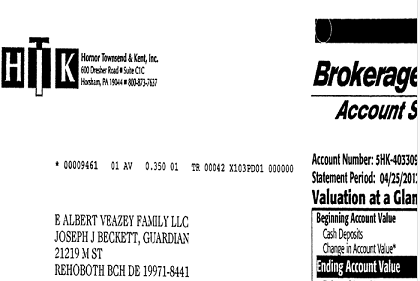
Rockwell/HTK
The family gifting trust has now been transferred to Jack Beckett.
Analyst Commentary: This is generally called theft.
Analyst Commentary: ... so what happened to funds moved from the LPL trust to the Penn Mutual, HTK "Guardianship" account controlled by DuBreuil and Jack? This get's good ...
Phase 3.4B: Account Intrusion & The Manufactured Fishing Expedition
Following the submission of the June 2011 Sharp Report—and perfectly aligned with DuBreuil’s transition to Rockwell Associates—the campaign shifted from external court filings to direct financial surveillance. Knowing that the legitimate estate ledgers contained zero evidence of wrongdoing, DuBreuil weaponized Jack's paranoia ("we have to catch him") to expand the scope beyond the estate entirely.
Procedural Subversion: The Wells Fargo Account Harvesting Scheme
The inclusion of Don Veazey’s business account in the court record was not an accidental administrative error; it was a deliberate, multi-stage maneuver executed by Jack, DuBreuil, and Sharp to force legal access to private, unrelated funds:
- Step 1: The Bank Reconnaissance (Pre-Report): Prior to the publication of the June 2011 Sharp Report, Jack and DuBreuil personally went to Wells Fargo to harvest specific account numbers under the broad pretext of identifying assets Jack allegedly "needed access to."
- Step 2: Weaponizing the Sharp Report: Armed with those harvested account numbers, Sharp inserted them directly into her formal investigation report, explicitly requesting that the court grant Jack access to those accounts—including Don Veazey's business line of credit.
- Step 3: Unquestioned Judicial Oversight: The court accepted Sharp’s request without performing basic due diligence. At no point did the court, investigator, or counsel question whether Jack had any legal entitlement, fiduciary duty, or legal standing to access a non-party financial records.
Forensic Insight:
Sharp served as the administrative conduit to legitimize Jack Beckett and DuBreuil’s unauthorized bank fishing expedition. By embedding private account numbers into an official court filing, they bypassed standard legal discovery protocols and obtained judicial cover for an unwarranted financial invasion.
Primary Record Evidence: Unauthorized Account Access
Bank security documentation from Wells Fargo (Account Access Manager) reveals that Joseph (Jack) Beckett was added directly to Don Veazey’s line of credit (Account ...7794) with "Offline Only" access.
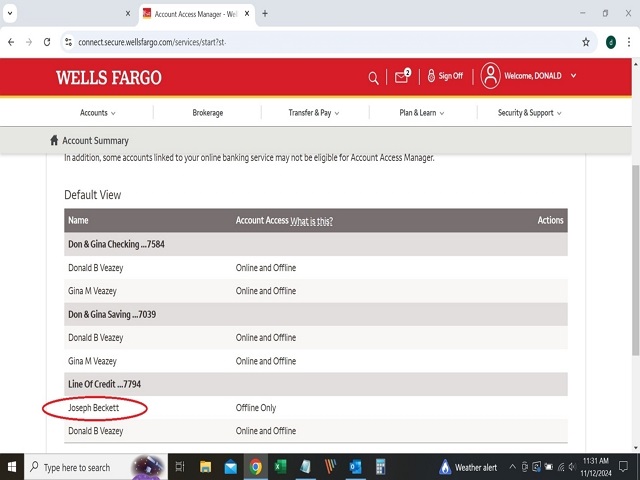
Operational Mechanics of the Subversion:
- The Unauthorized Net: Armed with offline administrative access, Jack pulled three full years of bank statements (2008–2011) covering an entirely separate business account belonging to Don Veazey — an entity with zero legal or financial standing in the estate.
- The DuBreuil Strategy: DuBreuil knew the records were entirely clean. However, dumping 36 months of routine personal and business transactions created the necessary volume to manufacture artificial complexity, misrepresent standard operational expenses as "suspicious," and keep Jack dependent on his guidance.
- Pretext for the Rockwell Transition: This data grab served as the immediate bridge between the Sharp Report and the upcoming Karsnitz Analysis—providing DuBreuil with the raw, distorted material needed to publish fabricated claims of theft under the guise of formal advisory at Rockwell.
Forensic Breakdown:
This was never a legitimate administrative audit. When actual estate records failed to yield proof of theft, the perpetrators expanded their net to an innocent spouse’s business account. Pulling 3 years of third-party statements was a calculated fishing expedition designed solely to sustain the illusion of an ongoing investigation.
Phase 3.5: Smoke & Mirrors (The DuBreuil Analysis / Karsnitz Report)
Days prior a meeting was held where "they all" got together. Thomas, Jack, DuBreuil, Kristen, Warrington?
March 1,2012
Young Conaway Stargatt & Taylor, LLP
110 W. Pine Street
P. O. Box 594 Georgetown, DE 19947
Re: E. Alberta Veazey
Analysis of Financial Transactions
Dear Robert,
Paragraph 1: DuBreuil Inserts Himself Between Jack, Thomas, Karsnitz, and the Courts
"As requested, the following is a summary of selected assets and asset movement pertinent to E. Alberta Veazey’s personal assets and her assets of Alberta Veazey Family LLC. My research was done at the request of Joseph J. “Jack” Beckett who is E. Alberta’s son and legal guardian. The final appointment of guardianship became effective on 6/24/2011."
Analyst Commentary: "selected assets and asset movement" - not comprehensive?
Analyst Commentary: It appears DuBreuil holds a misconception regarding the "her assets of Alberta Veazey Family LLC", seemingly conflating it with the estate of Alberta Veazey.
Paragraph 2: DuBreuil's Libelous and Slanderous Statements the courts
"In order to fulfill his duties as Alberta’s guardian Jack made a number of attempts, through you, as the attorney for Mrs. Veazey’s guardianship, to contact Jack’s brother, Donald B. (“Don”) Veazey, who had held Mrs. Veazey’s power of attorney, in order to make an orderly transfer of legal title of Alberta Veazey’s assets [Account Zero] over to the guardianship. Jack Beckett’s primary concern was and remains how to assure that he can satisfy his mother’s monthly nursing home bill (which approximates $6,000.00+/-month). From Jack Beckett’s perspective, Don Veazey has ignored or refused all of Jack Beckett's requests to transfer legal title of Alberta Veazey’s financial assets [Account Zero] to the guardianship."
Falsely asserting lack of communication: "Jack Beckett made numerous attempts..." DuBreuil simply wasn't part of the overall conversation and was oblivious to Ryan's ongoing contact with Thomas; all attorneys had ongoing discussions regarding Alberta's assets as detailed in Phase 3.4B. entirely mischaracterizes the situation.
Creates the illusion distressed assets: "to make an orderly transfer of legal title of Alberta Veazey’s assets [Account Zero]": I and my attorney Ryan have not ignored or refused any legitimate requests. DuBreuil has not provided, and cannot provide, any documentation to support this allegation. The opposite is supported in discovery. This paragraph is a direct and damaging falsehood.
Creates a Need to Act Now": "Don Veazey has ignored or refused all of Jack Beckett's requests to transfer legal title of Alberta Veazey’s financial assets [Account Zero] to the guardianship." Exhibits an overriding objective to transfer the funds to Rockwell Associates' management.
Awareness of Delaware Court Proceedings: DuBreuil was acutely aware that this statement would be used in Delaware and Virginia court proceedings within days of its publication. This awareness amplifies the gravity of his false statements and highlights the potential liability his employer faces due to his actions. He was not making an innocent mistake, but rather making a series of calculated false statements.
In Summary: DuBreuil has published false and unsupported statements. These statements are not only inaccurate but also potentially defamatory and damaging, especially considering their intended use in a legal proceeding.
Paragraph 3: Misrepresentation of Assets
"Alberta Veazey’s individual financial assets titled in her name appear to have been, as follows:
1) A Nationwide Annuity started on 12/22/2008 for $214,233.51
2) A brokerage account at Wells Fargo Advisers valued at $200,000 +/-.
3) Alberta’s share of the proceeds from a wrongful death lawsuit filed on behalf of her deceased husband Samuel Veazey and valued at $427,833.32 [Account Zero] as of 7/2009.
The total dollar value of the assets set forth above, as of the dates indicated, is $842,000 +/-. The dates and amounts of the assets were derived from statements which Jack Beckett was able to obtain and provide to me."
Analyst Commentary: No item listed above is an asset of Alberta's. The brokerage account at Wells Fargo Advisers should be valued at $19,000. No account has ever existed representing Alberta's "share" of the mesothelioma lawsuit settlement.
Paragraph 4: Unsubstantiated Wells Fargo Involvement
"The balance of this letter is a summary of my research, undertaken at Jack Beckett’s request, as to what has happened to Alberta Veazey’s financial assets. Jack Beckett chose me to conduct this research because I was Alberta’s banker and financial advisor while I was employed as a Sr. Financial Specialist at Wachovia Bank from 1/12/1999 to 5/7/2010; and, in that role, I had unique knowledge of the Alberta Veazey’s financial circumstances during that time. While working at the Bank I had gotten to know Alberta Veazey and her family; and I was instrumental in helping the family set up all of the accounts and orchestrating the movement of the assets related to the distribution of proceeds to the family members from Samuel Veazey’s wrongful death lawsuit. I currently am a Financial Advisor with Rockwell Associates in Wilmington, Delaware."
The Contradiction: "...because I was Alberta’s banker and financial advisor while I was employed as a Sr. Financial Specialist at Wachovia Bank..."
- No Broker Status: Under oath in deposition, DuBreuil conceded that he was never the broker of record on Alberta’s accounts.
- Lack of Advisory Activity: He could not identify or recall conducting any active investment management business for her during his tenure.
- Limited Functional Scope: Rather than functioning as a dedicated financial advisor steering her estate or investment portfolio, his role at Wachovia was strictly limited to executing standard, over-the-counter banking transactions.
In deposition Dubreuil clarifies:
MR. DUBREUIL: A "-- so I had knowledge of the -- of her finances, I knew everything, you know, about her finances."
then contradicts himself.
MR. DUBREUIL: A ...I mean in the past we hadn't really -- you know, I hadn't done any investment business for her [Alberta], I can't really remember the last time for her.
MR. MASSELLI: Q Did you handle that account?
MR. DUBREUIL: A I was not the broker of record on that account.
Specifics tell a different story: under oath, DuBreuil admitted he held no role in her outside assets. His claim of total financial knowledge exaggerates routine counter service into manufactured authority.
The Contradiction: "... I was instrumental in helping the family set up all of the accounts and orchestrating the movement of the assets related to the distribution of proceeds to the family members from Samuel Veazey’s wrongful death lawsuit."
Far from orchestrating financial movements smoothly, DuBreuil created significant risk when he deposited Alberta’s funds into the LLC’s money market account at Wachovia Bank on June 23, 2009, contrary to instructions. When confronted over the unauthorized move, he apologized, writing: "I am sorry for the missunderstanding... I will move the money... back to Alberta's money market this morning." Following this mishandling, he never handled another deposit, his inclination to act without authorization presented a risk of error.
Paragraph 5; Subsection 1: A Nationwide Annuity
"With reference to the current status of the respective above-identified financial assets, my findings are, as follows:
The assets comprising this annuity appear to have been transferred to the Nationwide Annuity Co. by Don Veazey in his capacity as Alberta Veazey’s PoA; and those transferred assets had accumulated through an annuity that Mrs. Veazey held for many years at the Transamerica Annuity Company (contract #26134746) (see exhibit B). The purchase of the Nationwide annuity occurred on 12/22/2008 and the initial funding was in the sum of $214,233.51. The most recent value of the annuity, based upon a phone call to Nationwide Annuity customer service on 3/6/2012, is currently $192,000 +/-. Don Veazey had made withdrawals from this annuity totaling $37,000 between 12/22/2008 and 1/31/2011; and, to date, he has not provided an explanation to Jack Beckett as to why these funds were withdrawn."
DuBreuil’s assertion that "to date, he has not provided an explanation to Jack Beckett as to why these funds were withdrawn" is factually incorrect. Jack was already fully aware that the funds were used to satisfy the LLC’s tax obligations. DuBreuil was completely uninvolved when the taxes were paid, and as an outsider to the transaction, there was simply no operational need to inform or include him.
Attorneys Ryan, Masselli, and Thomas had agreed, at the time DuBreuil authored this document, assets of the trust, including this annuity, would be reviewed after resolving Alberta's estate plan. DuBreuil was not included in these discussions.
"As of the date of this letter, the Nationwide Annuity is titled 'E. Alberta Veazey, Jack Beckett Guardian'. (see Exhibit C)"
Paragraph 5; Subsection 2: Wachovia/Wells Fargo Brokerage Account 46001-9730
"E. Alberta Veazey maintained the above non-qualified brokerage account with Wachovia Securities. During my tenure with Wachovia Bank as her banker and financial advisor I found Alberta to be a savvy investor always looking for ways to invest excess cash in stocks, bonds, and mutual funds. The value of this account had grown over the years to $200,000 +/-"
Paragraph 5; Subsection 3
"An informational notice from First Clearing, LLC, the transactional clearing division on Wachovia Securities (see exhibit D), dated 8/12/2008 shows an account registration change from E. Alberta Veazey TOD Registration to E. Alberta Veazey TOD Registration, Donald B. Veazey PoA."
Attorney Ryan and Nationwide collaborated to ensure the annuity was correctly payable to Don as the trust manager. Subsequent distribution of these proceeds would then be governed by the terms of the trust agreement.
Paragraph 5; Subsection 4: Complete Liquidation of This Segment of E. Alberta Veazey’s Financial Assets
"Based upon an entry on page 2 of exhibit I this account is now closed. Year end 1099 tax reporting statements provided by Wachovia Securities for tax years 2008, 2009, and 2010 along with E. Alberta Veazey’s 2010 tax return (see exhibit E) show that since Don Veazey had been added as PoA to this account in Aug of 2008 $276,320.79 in stocks, bonds and mutual funds had been sold (see 1099-B IRS Box 2 on each tax statement) resulting in the complete liquidation of this segment of E. Alberta Veazey’s financial assets. The 2010 tax return for Alberta shows a $43,187 capital tax loss possibly related to the sale of the financial assets within the brokerage account."
Upon maturity, the municipal bonds paid out, and Wells Fargo's systems automatically transferred the proceeds to Alberta's money market account. This left the account with only legacy investments of no significant relevance. Don subsequently liquidated these remaining investments, leaving Alberta with a few thousand dollars. During Don's approximately monthly visits, he and Alberta would discuss stocks and occasionally make minor trades together.
MR. MASSELLI: Q Now, looking at page two, the section on Wachovia/Wells Fargo brokerage account, when you wrote this letter, did you know that the Wells Fargo brokerage account still existed?
MR. DUBREUIL: A Yes.
MR. MASSELLI: Q So the statement that the entire brokerage account was liquidated was incorrect?
MR. DUBREUIL: A Entire? Let me see.
MR. MASSELLI: Q If you look at the last --
MR. DUBREUIL: A Yeah, I know, I saw that ...
Paragraph 5; Subsection 5: Why Isn't the Money Still in the Investment Account?
"Because these assets were titled in Alberta’s name, and were not considered as part of the Gifting Trust nor the Family LLC Jack Beckett reasonably assumed these financial assets would be available for him to use as needed to help him fulfill his duties as his mother’s legal guardian. Jack would like an accounting from Don Veazey in his role as Alberta’s PoA as to why the entire brokerage account was liquidated and how the proceeds were spent between 8/12/2008 and 12/31/2010."
When the proceeds were automatically moved by Wells Fargo, Don contacted DuBreuil, then a Wells Fargo employee.
I will provide an email exchange with DuBreuil regarding money automatically moving from the investment account to Alberta's checking. DuBreuil explains in an email to me (2008) that is how the account was set up - proceeds from asset sales would automatically move to checking.
DuBreuil admits in deposition he was aware at the time of writing, "entire brokerage account was liquidated" was not true.
The initial contact with DuBreuil concerned the automatic movement of funds from asset sales to Alberta's checking account, a process confirmed by DuBreuil in a 2008 email as the intended account setup. This routine operation is separate and distinct from the subsequent and complete liquidation of the entire brokerage account. DuBreuil's later deposition testimony clarifies that his earlier description of the "entire brokerage account being liquidated" was known to DuBreuil to be inaccurate.
Paragraph 5; Subsection 6: Alberta Veazey’s Share of Samuel Veazey’s Wrongful Death Lawsuit
"On 7/30/2009 the sum of $427,833.32 [Account Zero] was deposited in two equal shares into two money market accounts at Wachovia Bank. The title of one account (Account #1) was E. Alberta Veazey, POD Bob Beckett (acct #1010246822633) (see Exhibit F); and the title of the second account (Account #2) was E. Alberta Veazey, POD Jack Beckett (acct # 1010246822646) (see Exhibit G). This was done pursuant to a memorandum agreement of understanding dated 7/30/2009 (see Exhibit H) and signed by Alberta Veazey and each of her three sons — James Robert (“Bob”) Beckett, Jack Beckett and Don Veazey. A Wachovia bank printout dated 4/22/2011 reports these accounts to have been closed as of that date. (see Exhibit I)"
Analyst Commentary: During the 2009 calendar year, Alberta resolved approximately thirteen (13) separate legal actions and received approximately twenty-six (26) corresponding disbursements. One specific settlement in the amount of $427,833.32 [Account Zero] coincidentally approximates the $418,000.00 contemplated by the Memorandum of Understanding ('MoU'). The division of the aforementioned settlement amount of $427,833.32 into two equal shares yields $213,916.66, an amount proximate to the Federal Deposit Insurance Corporation ('FDIC') maximum insured deposit of $250,000.00, thus broken into 2 deposits to Money Market accounts.
This was not done pursuant to a memorandum agreement of understanding dated 7/30/2009 but is only 2 of 4 holding accounts owned by Alberta.
Analyst Commentary: DuBreuil states in deposition "don somehow got his share directly" - Yes, I did. That is how civil actions are disbursed.
"There are indications that Don Veazey, who then was the managing member of the E. Alberta Veazey Family LLC, transferred some, if not all, of the assets comprising Account #1 and Account #2 to Wachovia Bank (Account #20000 3103 3332) (see Exhibit J) which is a checking account titled under the E. Alberta Veazey LLC. This account appears to be used to pay various expenses of the LLC and maintain some asset liquidity."
Let's examine the evidence:
Wachovia's "Deposit to Close" documentation confirms that the account balances were transferred directly by DuBreuil into accounts belonging to Bob Beckett and Jack Beckett. These subsequent banking records trace the immediate aftermath of this movement, showing how the funds were systematically withdrawn, the original accounts closed, and the capital transferred into accounts under Jack and Bob Beckett's control. A fourth key document completes this paper trail, providing definitive proof that DuBreuil himself personally initiated these withdrawals and executed the final transfer of funds to Jack and Bob.
Penn Mutual’s agent, Thomas DuBreuil, demanded that clear evidence of asset transfer be produced. However, Penn Mutual held no legal standing to make such demands—only Beckett possessed any such standing. Satisfying these demands required securing legal counsel in both Delaware and Virginia at substantial personal and financial expense, solely to answer baseless and libelous allegations submitted to courts in both states.
Presented below is the evidence obtained through years of litigation, complicated by the fact that these are not Wells Fargo accounts; they are Wachovia accounts closed prior to the merger of Wachovia and Wells Fargo. Closed accounts were not transferred to Wells Fargo and were thus not available for branch walk-in access.
Examinig the evidence returned in subpoenas:
$427,833.32 divided into two equal shares yields $213,916.66, deposited into Account #1 and Account #2.
This evidentiary trail follows assets of "Account #1" DuBreuil alleges stolen by Don Veazey to Jack Beckett's Money Market
DuBreuil's "Account #1" - Alberta Veazey's High Performance Money Market
Account 1010246822646
E. Alberta Veazey
POD Jack Beckett
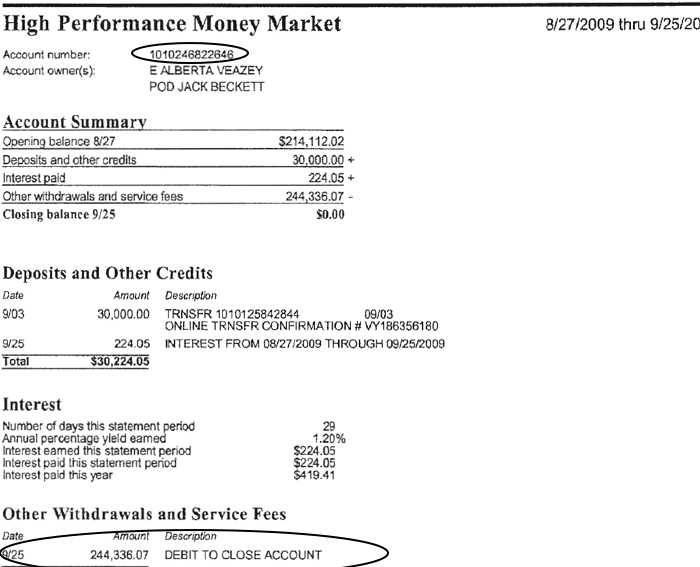
"Account #1"
| Initial deposit 8/27/2009 | $213,916.66 |
| Interest 7/27/2009 thru 8/26/2009 | $195.36 |
| Additional deposit | $30,000.00 |
| Interest 8/27/2009 thru 9/25/2009 | $224.05 |
| Total Value at withdraw 9/25/2009 | $244,336.07 |
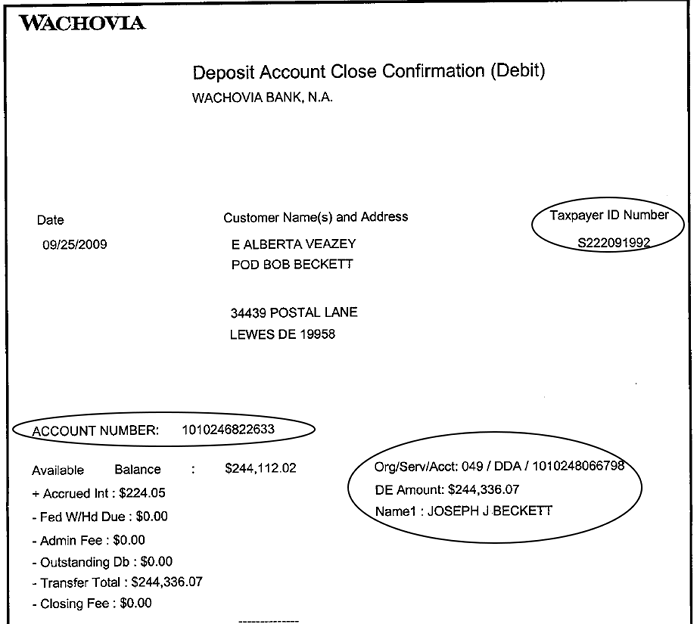
Debit to Close Account
$244,336.07; funds on hand at the time of closing
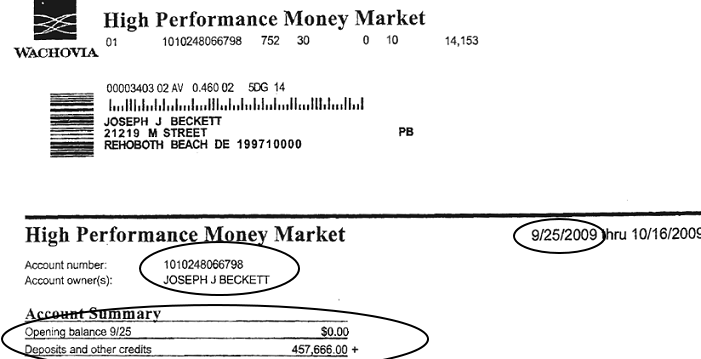
Deposit of "Account #1" funds into Jack Beckett's Money Market
Note, the total deposit of $457,666.00; the amount anticipated by the MoU
This evidentiary trail follows assets of "Account #2" DuBreuil alleges stolen by Don Veazey to Bob Beckett's Checking Account
DuBreuil's "Account #2" - Alberta Veazey's High Performance Money Market
Account 1010246822633
E. Alberta Veazey
POD Bob Beckett
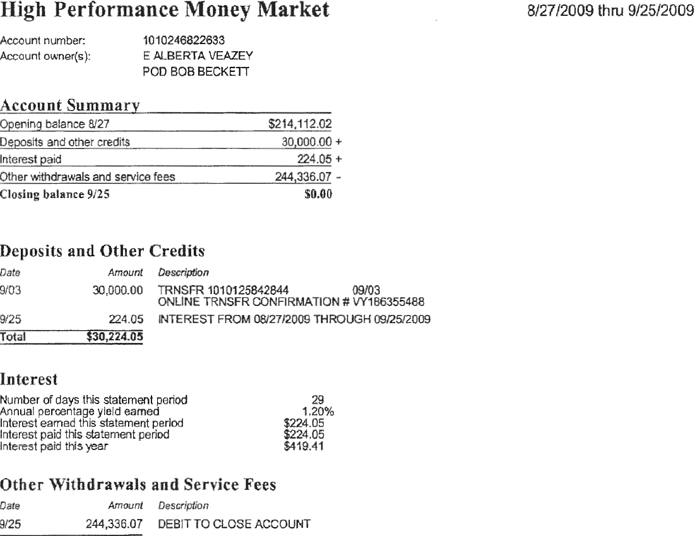
"Account #2"
| Initial deposit 8/27/2009 | $213,916.66 |
| Interest 7/27/2009 thru 8/26/2009 | $195.36 |
| Additional deposit | $30,000.00 |
| Interest 8/27/2009 thru 9/25/2009 | $224.05 |
| Total Value at withdraw 9/25/2009 | $244,336.07 |
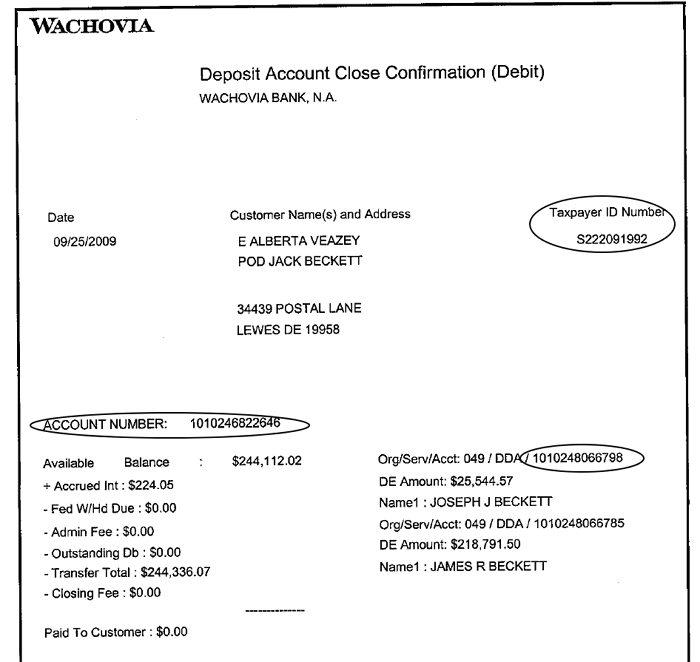
Debit to Close Account
$244,336.07; funds on hand at the time of closing
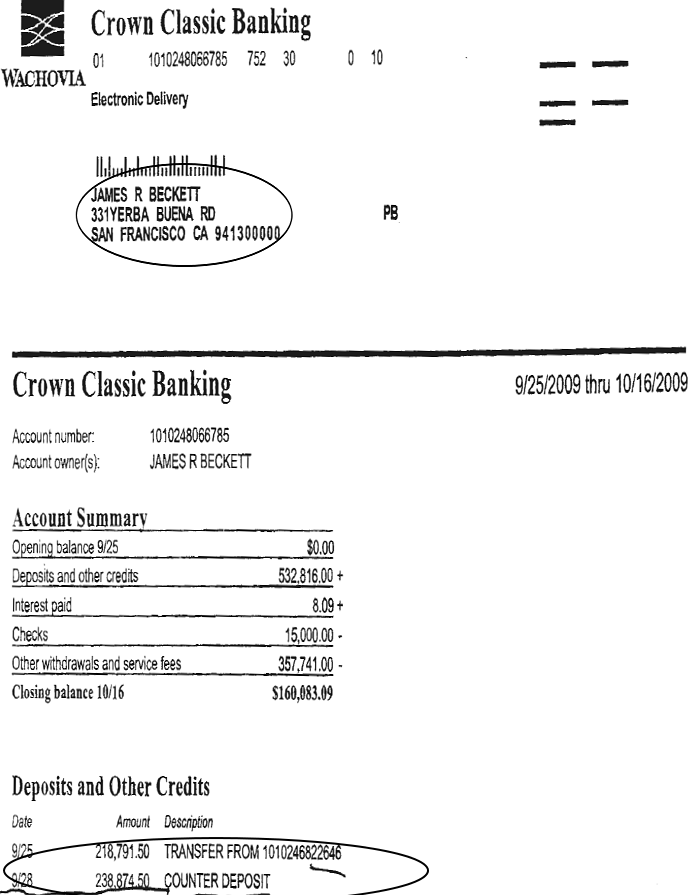
Deposit of "Account #2" funds into Bob Beckett's Checking
Note, the total deposit of $457,666.00 is represented; the amount anticipated by the MoU
A Wachovia printout of activity for account 20000 3103 3332 (see exhibit K) shows check #1019, in the amount of $285,000.00, clearing this account on 2/5/2010. Coincidentally, an account summary, printed on 5/31/2010 (see exhibit L), with respect to LPL Financial brokerage account #545 1-7282 (see exhibit M), titled E. Alberta Veazey Family LLC), shows that this account was opened on 2/4/2010 on the strength of an initial investment of $285,000.00. This account would appear not to be part of the Alberta Veazey’s guardianship estate.
DuBreuil got something right.
"Relating to the future management of the above assets Jack Beckett has sent a letter of instruction (see Exhibit N) to LPL Financial relating to the brokerage account #5451-7282 informing them that Don Veazey has elected to resign both as trustee of the E. Alberta Veazey Gifting Trust and non-member manager of the E. Alberta Veazey Family LLC (see Exhibit O). The instructions with the letter are pursuant to the attached Action of Sole Member naming Jack Beckett as trustee of the trust and managing non member of the LLC. LPL Financial has not responded to the request."
"In conclusion, my findings are that, between 12/22/2008 and 7/30/2009, Alberta Veazey had financial assets titled in her name with an aggregate value of $842,000 +/-. Today, it appears that only the Nationwide Annuity, with a value of $192,000.00+/-, is owned by Alberta Veazey (albeit now by Jack Beckett, in his capacity as Alberta Veazey’s guardian)."
"Currently unaccounted for, based upon my research (which, as indicated above, was limited due to the lack of complete records), are, the following:
1. The premise for and ultimate disposition of the $37,000 withdrawal from the Nationwide Annuity.
2. The premise for and ultimate disposition of the $276,321 transferred from the Wachovia brokerage account.
3. The disposition of the $142,833.32 not deposited to the E. Alberta Veazey Family LLC account at LPL Financial."
"Once you have considered the findings summarized by this letter, do not hesitate to contact me with any questions.
Sincerely yours,
Thomas DuBreuil
Financial Strategist
Rockwell Associates"
cc: File
Mr. Joseph J. Beckett
Summary Rebuttal:
Close scrutiny of this document leads to a belief this document a poorly conceived, challenging but not insurmountable attempt, using smoke and mirrors, to obfuscate theft of the trust fund's assets.
Phase 3.6: The Execution (The Grab)
[Drafting Note: mapping the mechanics of the actual asset or power seizure.]
May 10, 2012, Mr. DuBreuil transferred all assets, from LPL (IEN 27-0441192) to the Rockwell/HTK account (5HK-403309), opened April 25, 2012 Alberta’s SSN . I understand the ETFs were later liquidated, with the funds going to a Money Market account, also opened April 25, 2012.
The Rockwell/HTK (5HK-403309) account should have been included on guardianship filings as an asset owned by Alberta at that time and is relevant in preparing her first accounting.
It was not.
Bob,
Just as an FYI I spoke to Jack yesterday. He told me about the meeting you Jack and Kristen had last Friday. As I understand it the result of the meeting was for Jack to respond to his brothers letter point by point. I told him it was a good idea. I offered him my help in compiling a response, that offer extends to you as well. ...
Finally some good news. The Veazey Family LLC brokerage account that was at LPL Financial is now under my management. The transfer happened yesterday.
Sincerely yours,
Thomas DuBreuil, MBA
Catastrophic Fallout:
[Drafting Note: This section will establish the Virginia litigation.]
4.1: Don Veazey Notified of Asset Movement
[E-mails]
4.2: DuBreuil Asset Movement / Estate Management
[E-mails]
4.3: Veazey vs Beckett: A Demand for Explanation
[Veazey request for ...]
4.4: Beckett Counter Claim: A Demand for Release of [Account Zero]
MOTION TO INTERVENE AND MOTION TO FILE ADDITIONAL COUNTERCLAIM AND CROSS-CLAIM
...
5. Among Intervener's duties as Guardian of the property of E. Alberta Veazey,
Intervener is to take control of the assets of E. Alberta Veazey.
6. While pursuing his duties as the Guardian of the property of E. Alberta Veazey, it
was discovered that Plaintiff had transferred funds [Account Zero] previously held by Mrs. Veazey into his sole
and separate name.
...
12. Intervener must answer to the Chancery Court in Delaware as to the status of Mrs.Veazey's assets.
...
P-2. For an award of attorney's fees and court costs in this behalf expended,
and for such other and further relief as this Honorable Court deems just and meet.
The DuBreuil/Rockwell Associates/Karsnitz Report submitted as "evidence".
Subpoena of Donald Veazey’s Urological Records - subpoenaed medical records submitted as "evidence".
Records Granted and Reviewed by Murphy, Ratlitff, Jack Beckett?, Tom DeBreuil?
Subpoena of Veazey's Ophthalmological Records - subpoenaed medical records submitted as "evidence".
Records Granted and Reviewed by Murphy, Ratlitff, Jack Beckett?, Tom DeBreuil?